
Rated PG

Released by Netflix, directed by Alastair Fothergill, Jonathan Hughes, and Keith Scholey.
- David Attenborough: A Life on Our Planet is a wildlife and environmental documentary released in 2020. The documentary was directed by Alastair Fothergill, Jonathan Hughes, and Keith Scholey and stars famous biologist and broadcaster David Attenborough. David Attenborough: A Life on Our Planet was well-received by critics, and awarded three Emmy Awards.
- Attenborough describes the film as his “witness statement” of biodiversity loss and habitat destruction over his lifetime. He is an experienced naturalist who has been making and narrating nature documentaries for over 60 years. David Attenborough: A Life on Our Planet showcases the destruction humanity has caused to natural ecosystems over the last 90 years, and what we can do to reverse it.
- You can watch the trailer for the film here.
How is this related to climate?
- David Attenborough: A Life on Our Planet documents the degradation of the Earth’s wild places over Attenborough’s lifespan. With poignant data, the documentary shows how humanity’s growth and greenhouse gas emissions have been destroying wildlife since the 1930s. In 1937, when Attenborough was a child, the concentration of atmospheric carbon was 280 parts per million (ppm) and much of the world’s wilderness remained. In 2020, when the film was released, atmospheric carbon had risen to 415 ppm and only 35% of wilderness persisted.
- Elevated levels of atmospheric carbon dioxide (graph below), created by burning fossil fuels, are accelerating global warming and climate change. Carbon dioxide amplifies the greenhouse effect, the Earth’s natural process of trapping heat in the atmosphere.
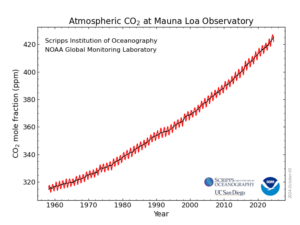
Graph of the concentration of carbon dioxide in the atmosphere, measured in parts per million (ppm), between 1960 and 2024. Note the steady increase in atmospheric carbon dioxide (from NOAA Global Monitoring Laboratory, 2024).
- The film goes on to provide a timeline of what will happen in the future if nothing is done to reduce anthropogenic carbon emissions and reduce the destruction of wilderness. The environmental devastation that would occur includes the transformation of the Amazon rainforest into a savannah, the complete loss of summer Arctic sea ice, and permafrost thawing in the 2030s and 2040s. From 2050 to 2080, coral reefs would become extinct, and global food production would crash, causing worldwide famine. In the 2100s, average global temperatures would have increased by 4°C (7.2°F).
- However, David Attenborough: A Life on Our Planet does more than document the causes of the climate crisis and its future effects. It also offers inspiration and a message of hope, outlining nature-based solutions to anthropogenic climate change and biodiversity loss. Attenborough stresses that the best way to reverse climate change is by stabilizing the global population, restoring wild ecosystems, and switching to renewable energy.
- Attenborough references nature-based approaches as the solution to the climate crisis, stating, “If we take care of nature, nature will take care of us.” These approaches involve action or policies restoring, conserving, or sustainably managing natural systems. Natural ecosystems prevent global warming by storing carbon. They also protect against the effects of climate change by providing resources to vulnerable groups and lessening the blow of climate-related disasters such as coastal flooding and heat waves.
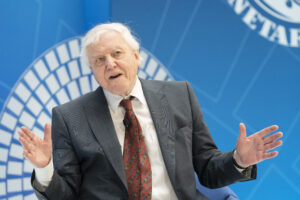
Photograph of David Attenborough speaking at the International Monetary Fund (IMF)/World Bank Spring Meetings in April 2019. Attenborough has spoken at several conferences, educating governments and business leaders about the perils of the climate crisis (from Earth.org, 2020).
References and additional resources
- Buis, A. “The Atmosphere: Getting a Handle on Carbon Dioxide.” NASA. October 2019. https://science.nasa.gov/earth/climate-change/greenhouse-gases/the-atmosphere-getting-a-handle-on-carbon-dioxide/.
- Cooper, A. “Sir David Attenborough explains what he thinks needs to happen to save the planet.” CBS News. September 2020. https://www.cbsnews.com/news/david-attenborough-climate-change-a-life-on-our-planet-60-minutes-2020-09-27/.
- “David Attenborough: A Life on Our Planet.” IMDb. 2020. https://www.imdb.com/title/tt11989890/
- “David Attenborough: A Life on Our Planet.” Wikipedia. February 2024. https://en.wikipedia.org/wiki/David_Attenborough:_A_Life_on_Our_Planet.
- Earth.org. “4 Key Takeaways From David Attenborough ‘A Life on Our Planet’” Earth.org. October 2020. https://earth.org/david-attenborough-new-film-a-life-on-our-planet/.
- “Monthly Average Mauna Loa CO2.” NOAA Global Monitoring Laboratory. July 2024. https://gml.noaa.gov/ccgg/trends/.
- Netflix. “David Attenborough: A Life on Our Planet | Official Trailer | Netflix.” Youtube. https://www.youtube.com/watch?v=64R2MYUt394.
- “What are nature-based solutions and how can they help us address the climate crisis?” World Wildlife Fund. November 2020. https://www.worldwildlife.org/stories/what-are-nature-based-solutions-and-how-can-they-help-us-address-the-climate-crisis.
- Winkelman, N. “‘David Attenborough: A Life on Our Planet’ Review: Ruin and Regrowth.” The New York Times. October 2020. https://www.nytimes.com/2020/10/04/movies/david-attenborough-a-life-on-our-planet-review.html.
How to cite this page
David Attenborough: A Life on Our Planet (2020). (2025, February 14). Climate in Global Cultures and Histories: Promoting Climate Literacy Across Disciplines. Retrieved Month Date, Year, from https://www.science.smith.edu/climatelit/david-attenborough-a-life-on-our-planet-2020/.