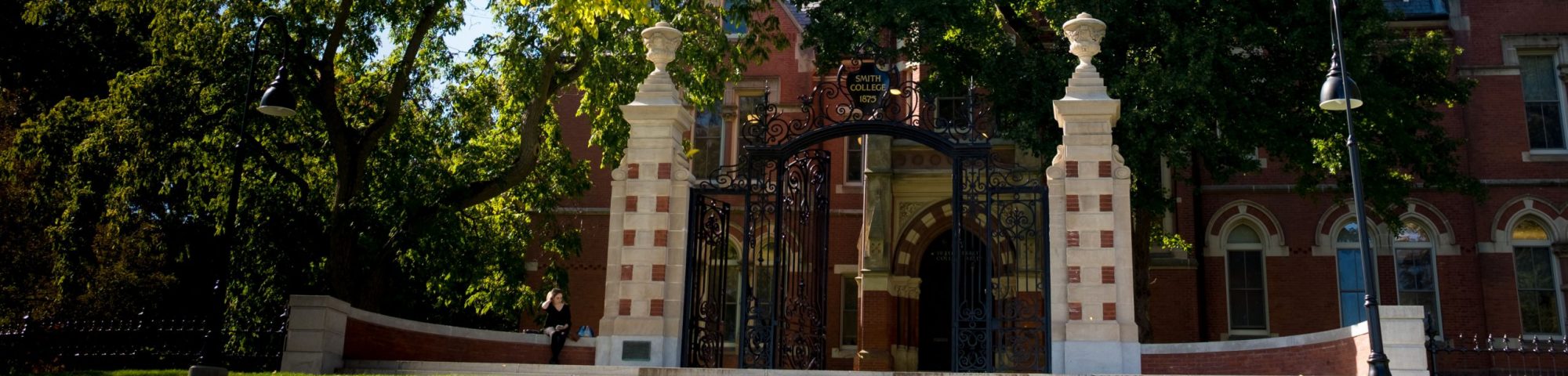
WIMIN 2024 was held at Smith College on Saturday, September 21, 2024.
Our plenary speakers were
- Lisa Traynor, Bryn Mawr College: An Unknotting Number in the World of Contact Topology
- Lidia Mrad, Mount Holyoke College: A Spacial Agent-Based Model for Mosquito Dispersal
Lisa Traynor, Bryn Mawr College.
An Unknotting Number in the World of Contact Topology
Mathematical knots can be modeled by tangled, closed loops of string in 3D-space. Legendrian and transverse knots are smooth knots that satisfy an extra geometric condition imposed by a contact structure. Many ideas for invariants for smooth knots can be transported to the setting of contact manifolds to study Legendrian and transverse knots. For example, the unknotting number is a classic and basic measure of complexity for smooth knots. I will introduce an unknotting number for transverse knots and explain how an ancestor-descendent relationship for smooth knots can be modified to define transverse family trees. Portions of this work was done with an undergraduate student Blossom Jeong (BMC 2020).
 Lisa Traynor is Professor of Mathematics and the Class of 1897 Professor of Science at Bryn Mawr College. Her research focuses on contact and symplectic topology, which concern the flexibility and rigidity of knotted objects under particular geometric constraints. After completing her PhD at Stony Brook, she was a postdoc at the Mathematical Sciences Research Institute (MSRI), Stanford, and at the Institut Henri Poincaré, and has been a research visitor at MSRI, the Institute for Advanced Study (IAS), and the American Institute of Mathematics. She has also been involved in many programs supporting women in the mathematical sciences, including the Women in Mathematics Program at the IAS, the Women in Geometry Workshops, and the WiSCon (Women in Symplectic and Contact Topology) Workshop.
Lidia Mrad, Mount Holyoke College.
A Spatial Agent-Based Model for Mosquito Dispersal
Mosquito-borne diseases pose an increasing health threat, not only in tropical regions, but also in new areas such as North America and Europe. Aedes aegypti is a mosquito that transmits dangerous viruses, including dengue and zika. Understanding the local spatial dispersal of Aedes aegypti can lead to better intervention strategies for disease control. I will present a diffusive agent-based model for mosquito dispersal, focusing on methods that accurately determine the associated diffusion coefficient. I will highlight some mathematical tools needed for designing the computational code, as well as techniques for analyzing data resulting from simulations that closely mimic field experiments. Our results refine the interpretation of field data and suggest improvements in their measurement.

2024 Schedule
The conference will took place from 9:30am-5:00pm EDT, and begins with coffee and a light breakfast.
Parking Information: After 5 p.m. and before 7 a.m., Monday through Friday and on weekends, visitors may park in the white lined spaces in any lot without a parking pass. We suggest parking in the Dickinson Lot on Green Street or the Parking Garage on West Street. Metered parking is also available on Green Street.
DETAILED SCHEDULE OF STUDENT TALKS
1-PAGE SCHEDULE OF STUDENT TALKS
FULL SCHEDULE
9:30 Registration, Coffee and light breakfast (Campus Center Atrium)
10 Welcome (Campus Center, Carroll Room)
10:05 Morning Plenary Lecture: (Campus Center, Carroll Room)
Spacial Agent-Based Model for Mosquito Dispersal
Lidia Mrad, Mt. Holyoke College
11:10 Student talks in parallel sessions (Various Rooms, McConnell Hall)
12:10 Lunch (Campus Center, Carroll Room)
1:20 Graduate School Panel (Campus Center, Carroll Room)
2:20 Student talks in parallel sessions (Various Rooms, McConnell Hall)
3:20 Coffee break and special exhibit: Do Plants Know Math? (McConnell Foyer)

4:00 Afternoon Plenary Lecture: (Campus Center, Carroll Room)
An Unknotting Number in the World of Contact Topology
Lisa Traynor, Bryn Mawr College