
This page contains the following sections:
- Where is German spoken?
- Climate education (in progress)
- Climate and culture in:
- Language practice (in progress)
- References and additional resources
Where is German spoken? (Wo wird Deutsch gesprochen?)
- German is a widely spoken Indo-European language with over 175 million speakers worldwide. Most German speakers reside in continental Europe, but many native and non-native speakers live throughout Africa, Australia, and the Americas. German is the official language of six countries: Germany, Austria, Switzerland, Belgium, Liechtenstein, and Luxembourg (map below).

Map of countries where German is an official language. The countries are shaded darker blue for a higher percentage of the population that speaks German (from Languages.eu, 2023).
Climate Education in Selected German-Speaking Countries (Klimabildung im deutschsprachigen Raum)
In progress.
Climate and Culture in Selected German-Speaking Countries (Klima und Kultur im deutschsprachigen Raum)
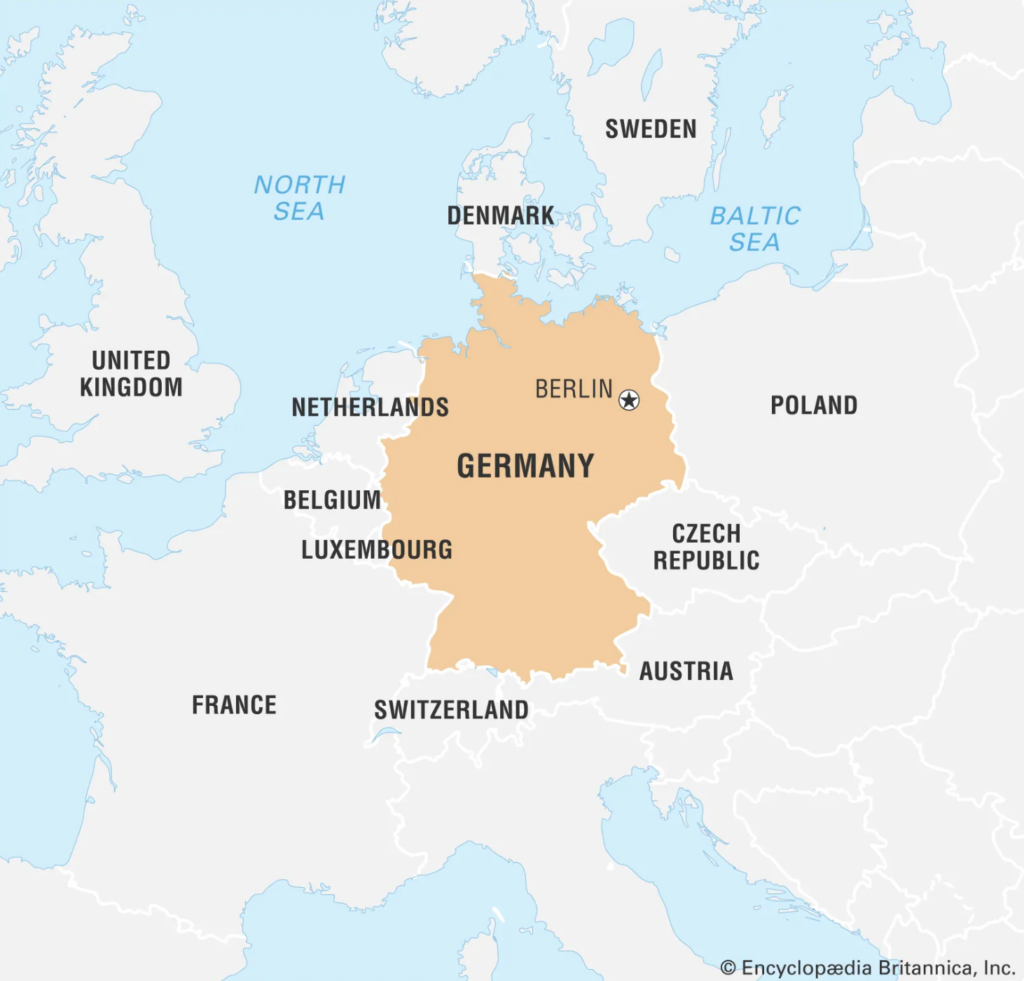
Map of Germany, located in north-central Europe (from Barkin and Strauss, 2024).
- Germany (map above) is home to over 80 million German speakers, with over 95% of the country’s population speaking German.
- Germany has a temperate continental climate, with typically predictable seasonal weather (saisonales wetter). Winters are cold with average temperatures between 0°C and 3°C (32°F and 37°F). Summers are normally cool and rainy. However, due to climate change, heat waves are becoming more common from late June to mid-August and can result in temperatures higher than 37°C (99°F).
- The mild seasonal climate is regulated by the North Atlantic Current, an ocean current system that carries warm water from lower latitudes of the western Atlantic Ocean to the western coast of Europe (map below).
- Precipitation in Germany is fairly consistent. The country’s agricultural industry is supported by abundant and reliable rainfall throughout the year. Lower altitudes are drier, with an average of 540 millimeters (21 inches) of precipitation annually in the plains surrounding the capital city of Berlin. In mountainous areas of Germany, precipitation is more plentiful and some areas average over 1,500 millimeters (60 inches) every year.
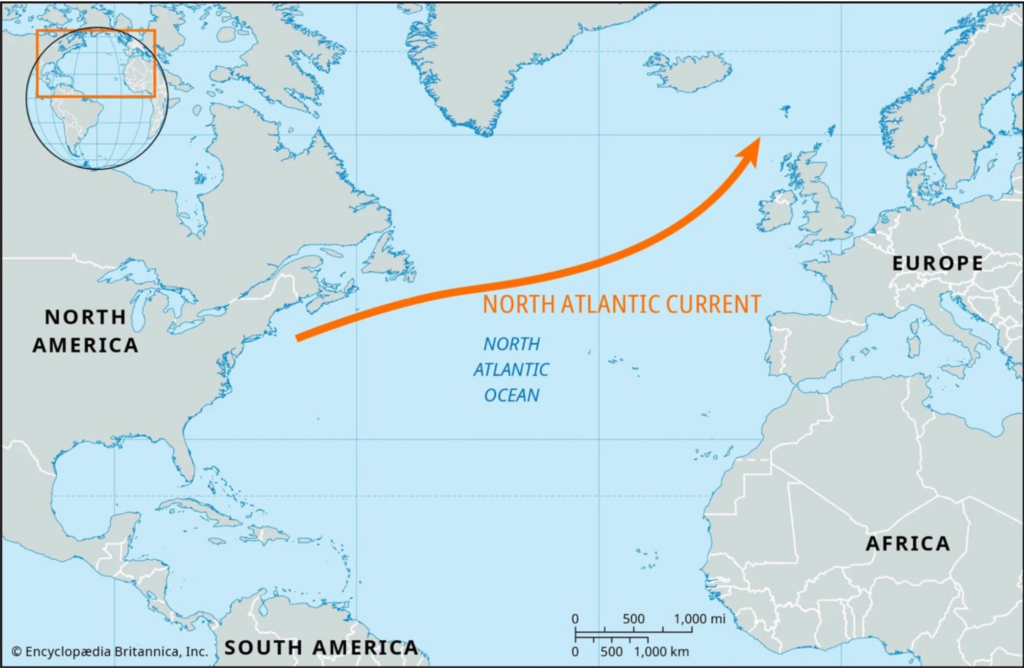
Map of the North Atlantic Current, an ocean current that stretches from the eastern coast of North America to the northwestern coast of Europe. The current brings warm waters to Western Europe, maintaining a mild climate in Germany and other parts of the continent (from The Editors of Encyclopaedia Britannica, 2023).
- Climate change is affecting several aspects of German culture, including food and drink. For example, beer is a popular alcoholic beverage in Germany. The country is known for some of the world’s best quality beer, with a distinct variety of flavors. Oktoberfest is a popular two-week-long beer festival in Munich every October (image below). Over 75,800 hectoliters (2 million gallons) of beer are consumed at the festival each year. Oktoberfest also features adorned wagons and floats carrying people in traditional German folk outfits.
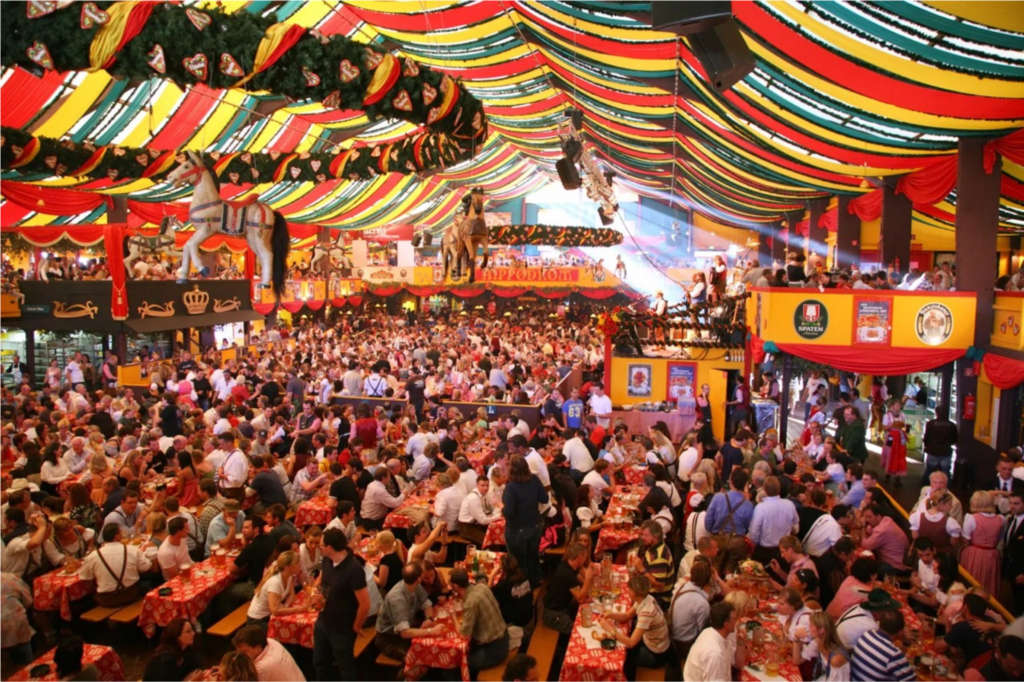
Photograph of patrons in a beer garden during Oktoberfest, a popular German festival in Munich (from The Editors of Encyclopaedia Britannica, 2024).
- Due to warmer weather and reduced precipitation, hop yields in Germany are on the decline, in both quantity and quality. Hops (image below) are a flowering herb and the primary flavoring agent in beer brewing. Warmer temperatures have shifted the hops’ growing season earlier in the year. Furthermore, more frequent heat waves, storms (stürme), and droughts are threatening hop production, particularly in small agricultural regions of Germany. Experts predict that hop yields will decline by 18% by 2050. Drier conditions are also reducing the alpha acid content of hops, which gives beer its bitter flavor.
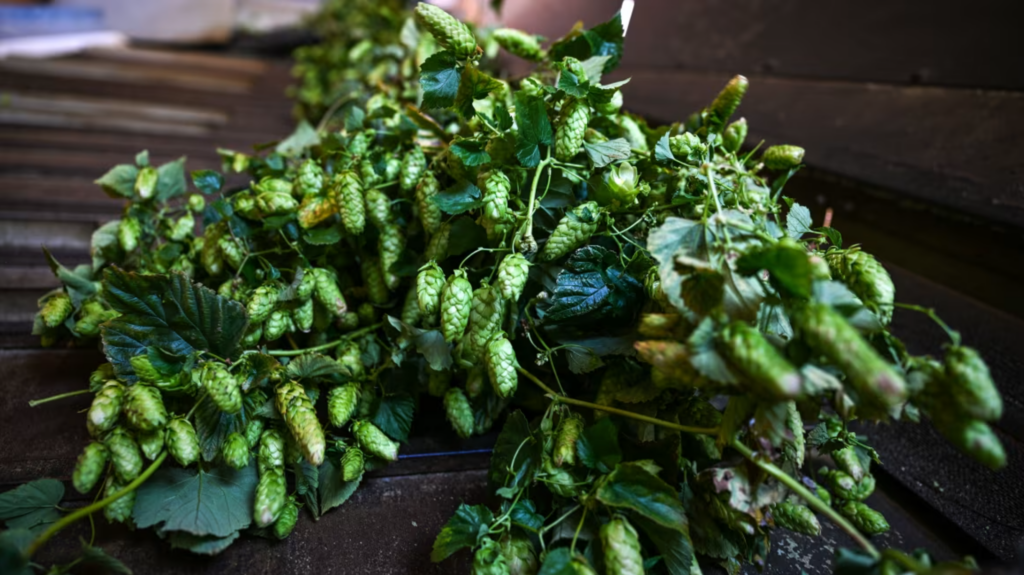
Photograph of harvested hop vines or bines grown in Germany. Hops are the flowers of the plant responsible for flavoring beer (from Ramirez, 2023).
- Decreased precipitation is also making hop production more expensive for farmers, who need to pay more to upgrade their irrigation systems to counter drought. In regions affected by lessened rainfall, farmers are forced to install pipes from groundwater sources or nearby reservoirs to their fields. As a result, the state of Bavaria, located in southeastern Germany, has pledged 40 million euros to help support farms by improving agricultural infrastructure.
- Agricultural researchers are developing drought and heat-resistant hop crops in an effort to adapt to climate change. Growing crops that are more weather-tolerant will save farmers time and money. However, consumers and growers alike are skeptical that new hop varieties will have a different taste.
- Forests are an important part of German cultural identity and are considered an important source of the country’s economic and cultural wealth. The importance of trees in German culture dates back to the beliefs of Germanic tribes. Native basswoods and oaks were worshiped as important spiritual symbols. Deep symbolic appreciation for forests continued in the 19th century through German fairytales, many of which portrayed woods as a location associated with mysticality. More recently, in the Industrial Age, forests became an important source of timber, which spurred movements of conservation (erhaltung) and reforestation (wiederaufforstung) in Germany.
- Today, climate change is threatening the health of many forests in Germany (image below). Drought has left trees vulnerable to bark beetles, which kill large swaths of forest. German forests are particularly vulnerable to warming conditions as many diverse native forests were cut down for lumber and replaced with less heat-resistant pines hundreds of years ago. These pines are experiencing heat stress due to rising temperatures, which is increasing the tree mortality rate.
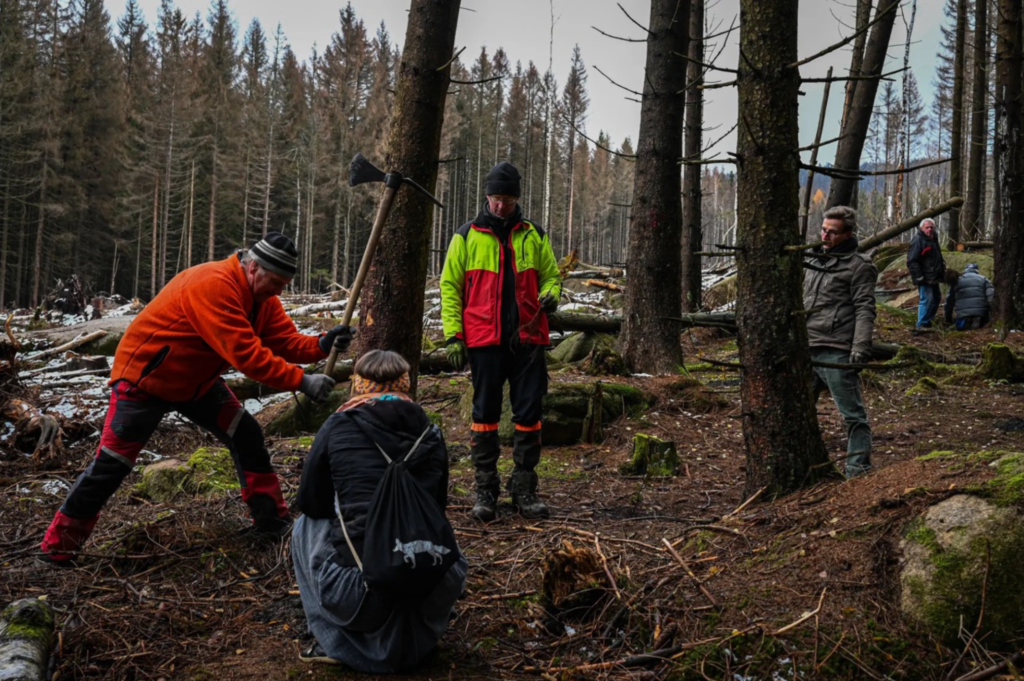
Photograph of a ranger and volunteers planting trees at Harz National Park in Germany. This is part of an effort to reforest areas made vulnerable to climate change. Over four hundred thousand acres of forests in Germany are dying or have died due to heat stress and pests (from Eddy, 2019).
Switzerland (Schweizerische Eidgenossenschaft)
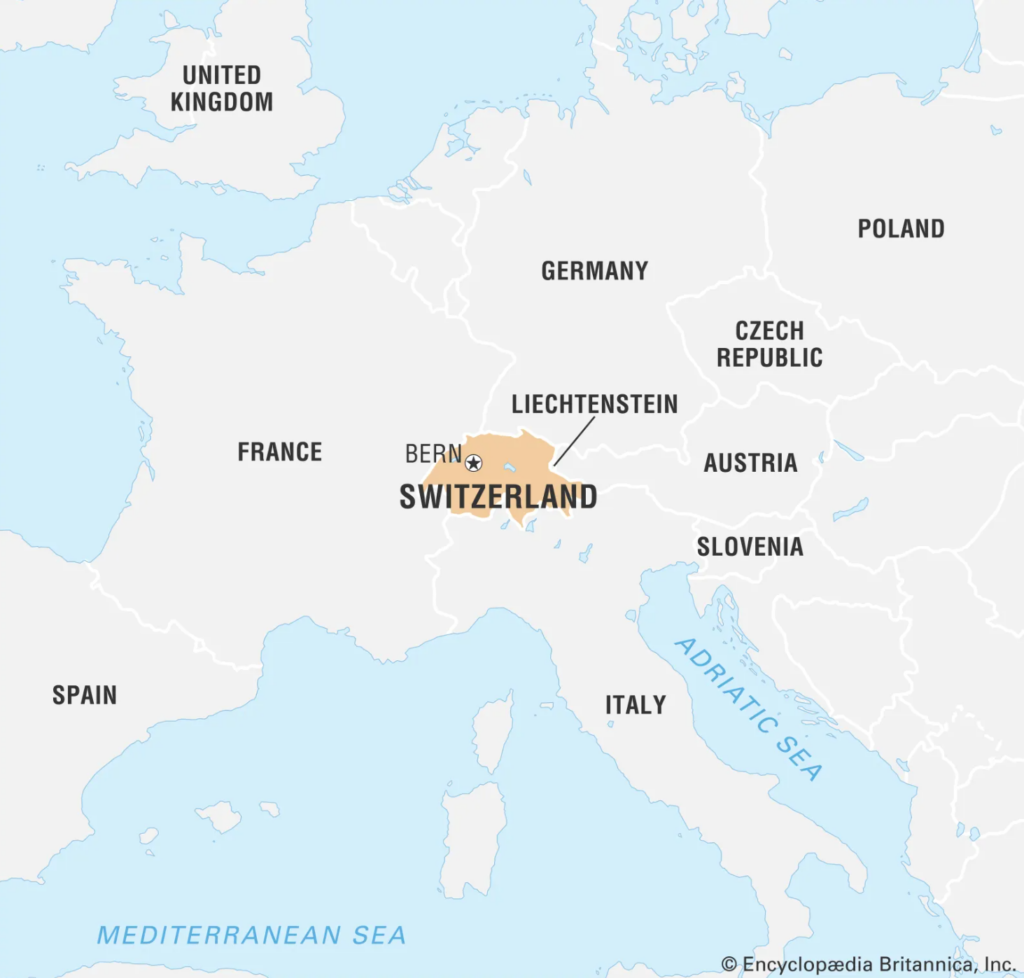
Map of Switzerland, located in the mountainous, Alpine region of central Europe (from Egli and Maissen, 2024).
- German is one of the four official languages– in addition to French, Italian, and Romansh– recognized by Switzerland. Over 60% of the population of Switzerland or about 5 million Swiss speak German.
- Switzerland is a landlocked, mountainous country with a continental climate. Winters are cold and sunny, while summers are warm and stormy. There are two broad types of climate, based on Swiss geography: the plateau and the mountains. On the central plateau of Mittelland, the climate is stable with reliable precipitation and average temperatures ranging from just above freezing in the winter to 20°C (68°F) in the summer. Temperature and precipitation vary by altitude in the Alps, a mountain range that runs through Switzerland. Generally, the higher altitude areas are colder and receive more precipitation.
- The climate in Switzerland is changing dramatically due to anthropogenic causes. Switzerland is warming twice as much as the global average, with temperatures 2.8°C (5°F) warmer than pre-industrial averages. Because there are no large bodies of water nearby to absorb excess heat, the temperature isn’t as regulated, causing excess solar energy (Sonnen energie) to be stored in the air.
- Swiss geography and climate have shaped much of the culture in Switzerland. For example, the popularity of winter sports is due to the country’s cold temperatures and mountainous terrain. Winter activities like alpine skiing, sledding, ski jumping, curling, hockey, mountain climbing, ice skating, and many more are popular in Switzerland for locals and tourists alike. Alpine areas receive plenty of snow and ice, perfect for winter sports. Furthermore, numerous small alpine lakes scattered throughout the country become beautiful natural ice rinks during the winter (image below). Switzerland has hosted the Winter Olympics on two occasions, in 1928 and 1948.
- Because of anthropogenic climate change, winter sports throughout Switzerland are threatened. Snow is becoming less plentiful in lower-altitude Alpine regions, forcing some ski resorts to rely on artificial snow. Researchers predict that artificial snow demands could raise the country’s water consumption by almost 80% by the end of the century. Rising temperatures are cutting ski seasons short. Additionally, the warming atmosphere (atmosphäre) can hold more water vapor, causing snowfall to be replaced with heavy rainfall, which can further melt preexisting snow. According to climatologists, every decade snow depth drops by 3-4 cm (1.2-1.6 in) at low-altitude ski resorts in Europe.
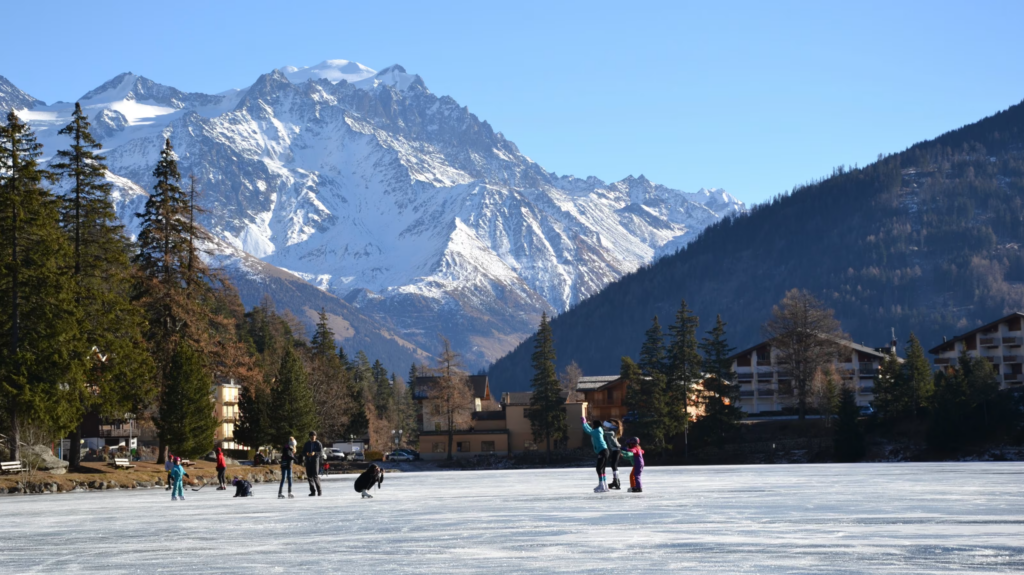
Photograph of Champex-Lac, a lake in southern Switzerland, during the winter. This lake becomes a beautiful high-altitude natural ice rink when frozen, and is nicknamed “Little Canada” (from Switzerland Tourism 2024).
- Climate also shapes agricultural traditions and festivities in Switzerland. For instance, Swiss farming and raising livestock revolves around the seasons, as Switzerland has a temperate climate. In Switzerland, cows, sheep, and goats are the most common animals raised. During the winter, livestock eat hay produced from the summer harvest. In the spring, many farmers take their herds up the mountains to Alpine meadows, where they will stay all summer to graze on freshly grown grass and shoots. The descent of the animals down the slopes back down to low-altitude flatlands is celebrated in mid-August to mid-September. The festival is called the Alpine Descent, or Désalpes in French and Alpabfahrt in German. This tradition is an ancient Swiss custom, originally meant to celebrate a loss-free summer.
- During the festival, livestock are marched through local villages in a parade. Cattle are typically adorned with vibrant crowns of twigs and flowers called Tschäppel (image below). Cows that produce the most milk are often given the most decorative crowns. Festivities like artisan markets, yodeling, traditional Alpine costumes, and local cheese are common in many villages.
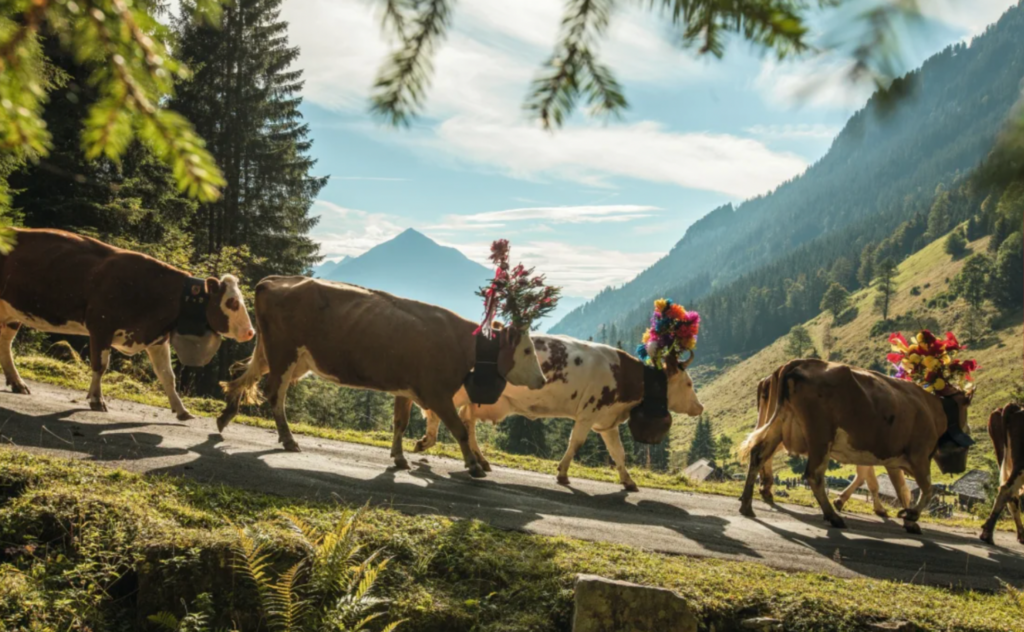
Photograph of a parade of cows in an Alpine Descent festival in Switzerland. The cows are adorned with flower crowns called tschäppl (from Switzerland Tourism, 2024).
- Chocolate is also a large part of the Swiss agricultural industry. The sweet dessert was first introduced in Switzerland from Central America in the 1800s. Famous Swiss chocolate-makers like Francois-Louis Cailler, Daniel Peter, and Rodolphe Lindt crafted high quality milk chocolate, cementing its popularity across the globe. Swiss chocolate (image below) is known for its smooth texture and richness. Chocolate is also a very popular treat in Switzerland, with the average resident consuming 25.5 pounds (11.5 kilograms) of chocolate every year. The annual Swiss Chocolate Festival, held in Versoix, Geneva, is a celebration of Swiss chocolatiers and their culinary work that brings tourists from around the world.
- As the largest importer of chocolate in the world, Switzerland relies heavily on cocoa from Africa, particularly from the Ivory Coast and Ghana which produce 60% of the world’s supply. However, climate change is contributing to rising cocoa prices, threatening the Swiss chocolate industry. Weather in these parts of West Africa is getting more extreme. During the rainy season heavy rain causes frequent flooding, and during the dry season high temperatures and strong winds destroy cocoa plants. These intense conditions, in combination with worsening pest problems, have, in part, have caused cocoa prices to skyrocket, reaching an all time high in 2024.
- As the largest importer of chocolate in the world, Switzerland relies heavily on cocoa from Africa, particularly from the Ivory Coast and Ghana which produce 60% of the world’s supply. However, climate change is contributing to rising cocoa prices, threatening the Swiss chocolate industry. Weather in these parts of West Africa is getting more extreme. During the rainy season heavy rain causes frequent flooding, and during the dry season high temperatures and strong winds destroy cocoa plants. These intense conditions, in combination with worsening pest problems, have, in part, have caused cocoa prices to skyrocket, reaching an all time high in 2024.

Photograph of Swiss chocolate, famous throughout the world for its good quality and decadent flavor (from Chandrasekhar, 2024).
Language practice
In progress.
References and additional resources
- “Alpine Farming.” Swiss Farmers. n.d. https://www.swiss-farmers.ch/knowledge-and-facts/production/alpine-farming/.
- Arvin, J. “How climate change fueled the devastating floods in Germany and northwest Europe.” Vox. July 2021. https://www.vox.com/22577431/germany-flooding-europe-climate-change.
- “Cattle descent from Alpine pastures.” My Switzerland. 2024. https://www.myswitzerland.com/en-ch/experiences/summer-autumn/autumn/cattle-descent-from-alpine-pastures/.
- “CCE Country Profile: Germany.” Monitoring and Evaluating Climate Communication and Education Project. 2024. https://mecce.ca/country_profiles/cce-country-profile-germany/.
- Chandrasekhar, A. “The chocolate of the future will have less cocoa or none at all.” Swissinfo.ch. May 2024. https://www.swissinfo.ch/eng/multinational-companies/the-chocolate-of-the-future-will-have-less-cocoa-or-none-at-all/78517426.
- “Chocolate in Swiss Culture: The Sweet Legacy of Swiss Chocolate.” Sensational Chocolates. n.d. https://sensationalchocolates.com/chocolate-in-swiss-culture/.
- Dahm, J. “German farmers hit by climate change impacts, new data shows.” Euractiv. August 2023. https://www.euractiv.com/section/agriculture-food/news/german-farmers-hit-by-climate-change-impacts-new-data-shows/.
- Eddy, M. “Climate Change Strikes at the Heart of German Identity: The Woods.” The New York Times. December 2019. https://www.nytimes.com/2019/12/24/world/europe/germany-climate-change-forests.html.
- Edmondson, C. “Germany’s Oldest Hops Thrived for Centuries. Then Came Climate Change.” The New York Times. September 2023. https://www.nytimes.com/2023/09/12/world/europe/beer-taste-hops-climate-change.html.
- Federal Office for Meteorology and Climatology. “Climate Change.” MetroSwiss. 2024. https://www.meteoswiss.admin.ch/climate/climate-change.html.
- Gerretsen, I. “How climate change threatens to close ski resorts.” BBC. January 2023. https://www.bbc.com/future/article/20230124-how-climate-change-threatens-to-close-ski-resorts.
- Hamerow, T. S. and Duggan, L. G. “Germany.” Encyclopaedia Britannica. July 2024. https://www.britannica.com/place/Germany.
- Languages.eu. “Countries where German is the official language.” Maps on the Web. November 2023. https://mapsontheweb.zoom-maps.com/post/735238298495287296/countries-where-german-is-the-official-language.
- “New study shows risks of climate change in Germany.” Umwelt Bundesamt. June 2021. https://www.umweltbundesamt.de/en/print/88488.
- Pariona, A. “German Speaking Countries.” World Atlas. June 2018. https://www.worldatlas.com/articles/territories-and-countries-where-german-is-an-official-language.html.
- Rascoe, A. and Selyukh, A. “It’s not your imagination– chocolate has been getting more expensive.” NPR. March 2024. https://www.npr.org/2024/03/31/1241888350/its-not-your-imagination-chocolate-has-been-getting-more-expensive.
- Ramirez, R. “The climate crisis is coming for your hoppy beer.” CNN Business. October 2023. https://www.cnn.com/2023/10/10/business/hops-beer-europe-threatened-climate/index.html.
- Redaktion. “Exploring German Culture and Traditions.” Life in Germany. August 2023. https://en.life-in-germany.de/exploring-german-culture-and-traditions/.
- Sen Nag, O. “The Culture of Switzerland.” World Atlas. October 2020. https://www.worldatlas.com/articles/the-culture-of-switzerland.html.
- The Editors of Encyclopaedia Britannica. “North Atlantic Current.” Encyclopaedia Britannica. July 2023. https://www.britannica.com/place/North-Atlantic-Current.
- The Editors of Encyclopaedia Britannica. “Oktoberfest.” Encyclopaedia Britannica. June 2024. https://www.britannica.com/topic/Oktoberfest.
- “The eight best natural ice rinks in Switzerland.” My Switzerland. 2024. https://www.myswitzerland.com/en-ch/planning/about-switzerland/sustainability/sustainable-activities/sustainable-winter-activities/the-eight-best-natural-ice-rinks-in-switzerland/.
- Watchter, D. and Maissen, T. “Switzerland.” Encyclopaedia Britannica. June 2024. https://www.britannica.com/place/Switzerland.
- “Weather and Climate in Switzerland.” Climates to Travel. n.d. https://www.climatestotravel.com/climate/switzerland.
How to cite this page
German (Die deutsche Sprache). (2025, August 29). Climate in Global Cultures and Histories: Promoting Climate Literacy Across Disciplines Retrieved Month Date, Year, from https://www.science.smith.edu/climatelit/german/.