
This page contains the following sections:
- Where is Mandarin Chinese spoken?
- Climate education in China
- Climate and culture in:
- Language practice (in progress)
- References and additional resources
Where is Mandarin Chinese spoken? (哪个地区说普通话)
- Mandarin Chinese is one of the most widely spoken languages in the world with over 1 billion speakers. The vast majority of Mandarin speakers live in Asia. Mandarin is an official language in Mainland China, Taiwan, and Singapore (map below). While it is not an official language there, Mandarin is also widely spoken in Indonesia and Malaysia.
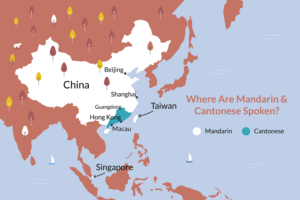
Map showing in white where Mandarin Chinese is commonly spoken, and in green where Cantonese is more widely spoken (from Boland, 2020).
Climate education in China (中国的气候教育)
- You can learn more about climate education in China through the Monitoring and Evaluating Climate Communication and Education (MECCE) Project here.
China (中国)

Map of China, located in East Asia, west of the Pacific Ocean (from Encyclopædia Britannica).
- China is currently the country with the highest carbon emissions (碳排放) in the world, though it has a lower per capita emission rate compared to countries like the U.S.A. Some of China’s greatest climate threats (气候威胁) include flooding (洪水), intense storms (暴风雨), and heat waves (热浪). Extreme weather conditions (极端气候条件) threaten people and agriculture in China. For example, irregular precipitation (不规律的降水) is causing notable water shortages (水资源短缺) in Northern China.
- As of 2020, China’s average air temperature and sea levels have increased faster than in other countries. Scientists attribute the faster-than-average sea level rise (海平面上升) to the local warming (局部变暖), thermal expansion of seawater, lower regional air pressure, anomalous winds, alongshore currents, and freshwater runoff (淡水径流) due to melting of glaciers (冰川融化). Many highly populated coastal cities could be inundated with rising sea levels. For instance, if global temperatures increase on average by 2°C (3.6°F) above pre-industrial levels, the sea level is projected to rise by 6 m (19.7 ft) by 2200 and a significant portion of Shanghai will be underwater, displacing an estimated 43 million people.
- According to a 2021 study by Yang and coauthors published by the American Geophysical Union, most of the Chinese public confuse climate change (气候变化) with more local environmental issues like regional air pollution (空气污染) and weather events. Many public awareness campaigns are focused on bringing higher social attention to climate change in China. For example, a 2016 event in Hong Kong called the Inter-School Cross-Curricular Project Competition on Climate Change educated students, teachers, and government officials through seminars and interactive workshops taught by climate experts.
- China has several nationwide climate education policies encouraging climate awareness among youth. For instance, the Guidelines for the Implementation of Environmental Education in Primary and Secondary Schools released by the Chinese Ministry of Education in 2003 require students to understand and discuss the causes of environmental disruptions (环境破坏).
- The Chinese government has made several efforts to improve climate education at the higher education level. In 2022, the Ministry of Education enacted an action plan for training a green workforce to plateau carbon emissions by 2030. The Chinese government has also enacted the Action Plan for Strengthening the Construction of Carbon Peak and Carbon-Neutral Talent Training System which established training programs that teach university educators green and low-carbon research skills. This action plan also encourages higher education institutions to invest in climate change and carbon neutrality research.
- A notable example of environmental restoration in China is the restoration of the Loess Plateau (image below), located in north-central China. The plateau is a highland area positioned around the Yellow River Basin and is home to more than 5 million people. While the Loess Plateau was known historically as the “breadbasket of China”, centuries of mismanagement–particularly overgrazing and planting crops on slopes–led to severe erosion and desertification across the plateau. In the early 1990s, China’s government partnered with the World Bank to repair the ecological damage in the Yellow River’s watersheds and help local communities on the plateau. Restoration strategies included: creating reservoirs to store water from seasonal rains (to avoid depleting limited aquifers), building warped dams in the river valley to create flat fields for farming and prevent erosion, terracing slopes to increase water and soil retention as well as crop yield, and eventually planting vegetation on terraced slopes to bind the soil and prevent further erosion. The restoration project was successful in making the Loess Plateau suitable for agriculture once more, while also reducing the risk of flooding from the Yellow River and increasing the income of the plateau’s residents.
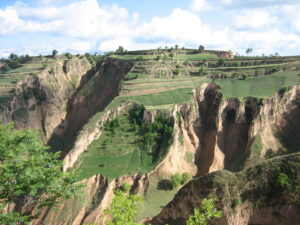
A photo of the Loess Plateau, located in north-central China, after restoration efforts (from Regeneration International, 2016). Erosion and desertification of the plateau has significantly decreased due to the sustainable management strategies implemented since the 1990s.
Climate and culture in selected Mandarin-speaking regions (普通话国家的气候和文化)
- China is a vast country in eastern Asia bordering the Pacific Ocean to the east (map above). This country’s climate is influenced by oceanic and continental air masses that affect humidity (湿度) and temperature (温度). In the summer, the Pacific air mass dominates Eastern China’s climate, bringing heavier rainfall and warmer temperatures. During the winter, the Siberian air mass from the north brings colder and drier weather to China.
- China has a complex topography (地形) and, as a result, a variety of climatic conditions (map below). Generally, temperatures are higher and precipitation (降雨量) is greatest in southeast China. Conversely, it is the coldest and driest in the northwestern region.
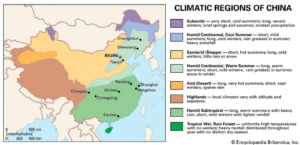
Map of the varying climate regions in China (from Encyclopedia Britannica, 2024). China’s climate zones range from the subarctic region in the northeast to arid deserts in the west and tropical rainforests in the southeast.
- Clothing styles in China are tied to the climate of the regions they are worn in. For instance, hanfu (汉服) is the name of the traditional garments worn by the Han Chinese people, the largest ethnic group in China and the world. The early Han people originally spoke the language Hanyu (汉语), which later developed into modern Mandarin Chinese. Hanfu originated during the Han Dynasty (206 BCE to 220 CE) and was designed to reflect the ideals of Confucianism, the predominant religion and philosophy at the time. Specific styles vary by region and culture, but the major components of Hanfu are the Yi (tunic top), Chang (skirt), and Shang (draped skirt/pants).
- While the stylistic elements of Hanfu are consistent throughout China, the fabrics vary by region and climate. For example, Hanfu from Northern China, where winter temperatures commonly reach -20°C (-4°F), are made of warmer fabrics like wool. In the South, where the climate is tropical, Hanfu is made from light silks and linens. In western China, the climate varies by topography and the region is divided into deserts, plateaus, and steppes. Temperatures in western China fluctuate greatly between seasons, and Hanfu from this region is made from a versatile blend of local and imported materials.
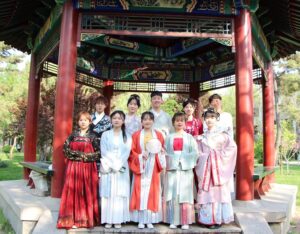
A photograph of college students wearing different kinds of hanfu (Wikimedia Commons, 2021). The material a hanfu is made of will often depend on the climate of the region it comes from: Northern Chinese hanfu are warmer and made of wool, Southern Chinese hanfu are lighter and made of silk.
- Climate also influences regional food in China. In fact, the Sichuan region, located in southwestern China (map below), is famous for its spicy food, which holds local cultural significance as heat from the food is meant to remove excess moisture from the body.
- This densely populated region sits on the upper Yangtze River and contains many valleys, which contribute to its mild and humid climate. The relative humidity is often high in the eastern Sichuan region, which receives over 40 inches (1 meter) of precipitation annually. In the summer, Sichuan gets very warm and humid, while in the winter it is chilly and damp.
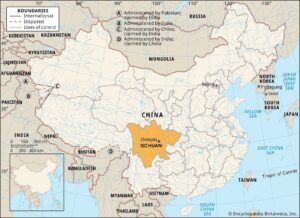
Map of the Sichuan region of China, the most populous and second-largest province in the country (from Suettinger and Hu, 2024).
- Many popular spicy dishes from Sichuan include chili peppers, which were introduced in China by Portuguese traders in the 16th century. Other spices like cinnamon, peppercorn, and cardamon are combined with chili to create flavorful cuisine. Mapo tofu (image below, left)– made of silken tofu, black beans, and ground beef– and dan dan mian (image below, right)– a noodle dish topped with cooked meat and pickled vegetables flavored with spices– are two popular foods originating from the Sichuan region.


Photographs of mapo tofu (top, from Distefano, 2020) and dan dan mian (bottom, from Distefano, 2020), two popular traditional dishes from the Sichuan region in China. The spiciness of Sichuan cuisine is attributed to its humid climate–it is commonly believed that the heat from the food removes excess moisture from your body.
- Taiwan is a subtropical island in the western Pacific Ocean (map below). The country has long, hot summers and short, cool winters. Taiwan’s climate is also impacted by monsoons (季风), which are seasonal wind patterns that bring heavy moisture in the summer and dry air in the winter. Summers reach an average peak temperature of 29°C (84°F) with plentiful rainfall (降雨) brought on by the summer monsoon. Winters, on the other hand, are cooler with average high temperatures around 19°C (66°F).
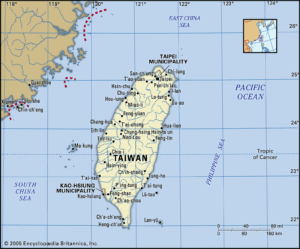
Map of Taiwan, an island in the western Pacific Ocean off the coast of mainland China (from Encyclopedia Britannica, 2024).
- Taiwanese culture is influenced by that of the Han Chinese and Indigenous Taiwanese people. The Tsou people are one of the many Indigenous Taiwanese people who are being impacted by climate change. The Dendrobium or golden grass orchid (image below left), referred to as the God Flower, is a culturally important flower to the Tsou. The God Flower is regarded as a gateway to the gods and is traditionally placed on the roofs of Kuba, a hall used for spiritual ceremonies like Mayasvi, a three-day religious festival (image below right).
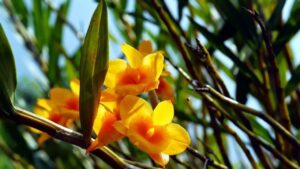
Photograph of the Dendrobium orchid or golden grass orchid, known as the God Flower to the Indigenous Tsou people in Taiwan (above).
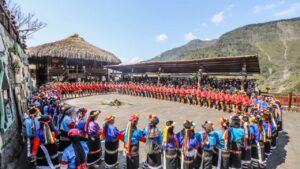
Photograph of Tsou people participating in the Mayasvi festival, an important cultural ceremony (right)(from McGovern, 2023).
- The God Flower is disappearing as a result of climate change. To bloom, the golden grass orchid must experience winter temperatures below 12°C (54°F). However, climate change is raising average temperatures. Climatologists believe that winters in Taiwan will heat up from 12-14°C (54-57°F) to 14-16°C (57-61°F) on average by 2050. Droughts (干旱) are also becoming more frequent, further threatening the abundance of the God Flower.
Language practice: vocabulary, grammar, and translation challenge
In progress.
References and additional resources
- “曲阜師範大学の洙泗部の写真.” Wikimedia Commons. April 2021. https://commons.wikimedia.org/wiki/File:曲阜師範大学の洙泗部の写真.jpg.
- Boyd-Moss, G. “Restoring China’s Loess Plateau, China.” ArcGIS StoryMaps. October 2022. https://storymaps.arcgis.com/stories/0aad088bf1ba46db8af3cc62bc2e88cc.
- “China.” Encyclopædia Britannica. February 2025. https://www.britannica.com/place/China.
- “CCE Country Profile: China.” Monitoring and Evaluating Climate Communication and Education Project. https://mecce.ca/country_profiles/cce-country-profile-china/.
- “Climate change in China.” Wikipedia. July 2024. https://en.wikipedia.org/w/index.php?title=Climate_change_in_China&action=history.
- “Climate – China.” Climates to Travel: World Climate Guide. n.d. https://www.climatestotravel.com/climate/china.
- “Climate Regions of China.” Encyclopedia Britannica Kids. 2024. https://kids.britannica.com/students/assembly/view/137856.
- “Climate – Taiwan.” Climates to Travel: World Climate Guide. n.d. https://www.climatestotravel.com/climate/taiwan#seasons.
- Copper, J. C. “Taiwan.” Encyclopedia Britannica. June 2024. https://www.britannica.com/place/Taiwan.
- Distefano, J. “More Than Málá: A Deeper Introduction to Sichuan Cuisine.” Serious Eats. January 2020. https://www.seriouseats.com/what-is-sichuan-szechuan-chinese-cuisine.
- Elman, B. and Twitchett, D. C., “China.” Encyclopedia Britannica. June 2024. https://www.britannica.com/place/China.
- HanfuSupplier. “What are the regional variations of Hanfu?” HanfuSupplier. January 2024. https://www.hanfusupplier.com/post/what-are-the-regional-variations-of-hanfu#Northern_Region_Variations.
- Hiller, B. and Liu, J. “A Continuing Inquiry Into Ecosystem Restoration: Examples From China’s Loess Plateau and Locations Worldwide and their Emerging Implications.” Regeneration International. January 2016. https://regenerationinternational.org/2016/01/22/a-continuing-inquiry-into-ecosystem-restoration-examples-from-chinas-loess-plateau-and-locations-worldwide-and-their-emerging-implications/.
- “Impact of Climate Change In Singapore.” NCCS Singapore. n.d. https://www.nccs.gov.sg/singapores-climate-action/impact-of-climate-change-in-singapore/.
- Johnson, I. “On the Role of Chinese Religion in Environmental Protection.” The New York Times. October 2016. https://www.nytimes.com/2016/10/18/world/asia/china-religion-prasenjit-duara.html.
- Maizland, L. “China’s Fight Against Climate Change and Environmental Degradation.” Council on Foreign Relations. May 2021. https://www.cfr.org/backgrounder/china-climate-change-policies-environmental-degradation.
- McGovern, N. “Taiwan: The ‘God Flower’ vanishing because of climate change.” BBC News. December 2023. https://www.bbc.com/news/world-asia-67342419.
- Quin Pollard, M. and Woo, R. “China’s Glaciers in Retreat.” Reuters Graphics. November 2020. https://www.reuters.com/graphics/CLIMATE-CHANGE/CHINA-GLACIER/rlgvdamqnpo/.
- Ravilious, K. “Terrawatch: why is sea level rising faster along China’s coast?” The Guardian. September 2022. https://www.theguardian.com/science/2022/sep/28/terrawatch-why-is-sea-level-rising-faster-along-china-coast.
- Reuters. “China says coastal sea levels hit new high in 2022.” Reuters. April 2023. https://www.reuters.com/business/environment/china-says-coastal-sea-levels-hit-new-high-2022-2023-04-12/.
- Strauss, B. “Coastal Nations, Megacities Face 20 Feet of Sea Rise.” Climate Central. https://www.climatecentral.org/news/nations-megacities-face-20-feet-of-sea-level-rise-19217.
- Su, Q. G. “Where is Mandarin Spoken?” ThoughtCo. November 2019. https://www.thoughtco.com/where-is-mandarin-spoken-2278443.
- Suettinger, R. L. and Hu, C. Y. “Sichuan.” Encyclopedia Britannica. July 2024. https://www.britannica.com/place/Sichuan.
- Yang, J., Gounaridis, D., Liu, M., Bi, J., and Newell, J. “Perceptions of Climate Change in China: Evidence From Surveys of Residents in Six Cities.” American Geophysical Union (AGU). November 2021. https://agupubs.onlinelibrary.wiley.com/doi/10.1029/2021EF002144.
How to cite this page
Mandarin. (2025, August 15). Climate in Global Cultures and Histories: Promoting Climate Literacy Across Disciplines. Retrieved Month Date, Year, from https://www.science.smith.edu/climatelit/mandarin.