Victoria Booth, University of Michigan.
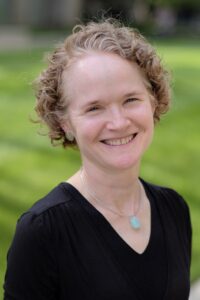
Victoria Booth is a Professor of Mathematics and Associate Professor of Anesthesiology at Michigan. Her research mathematically models the brain, especially including sleep-wake systems and the impacts of circadian rhythms on pain processing. Her work complements empirical studies, particularly in situations where it is not possible to measure or observe phenomena on a time scale that could validate neuroscience theory. Booth received her undergraduate degree from Smith College (1986) and her PhD from Northwestern. She has held research positions at the Center for Naval Analysis and the RAND corporation, as well as postdoctoral position at the National Institutes of Health. Booth has received many awards, including grants from the NIH, the NSF (both the division of biology and the division of mathematical sciences), and the Air Force Office of Scientific Research. More recently, she was honored with the 2023 J.D. Crawford Prize by the Society for Industrial and Applied Mathematics (SIAM) Activity Group on Dynamical Systems, in recognition of her “exceptional research in mathematical biology and, in particular, the formulation, analysis and interpretation of dynamical systems models of sleep-wake cycles.”
Title: Modeling developmental changes in sleep-wake behavior
Isabel Vogt, Brown University.
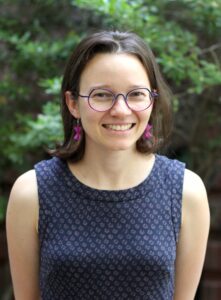 Isabel Vogt is an Associate Professor of Mathematics at Brown University. Her research is between algebraic geometry and number theory, focusing on questions about algebraic curves as well as rational and low-degree points on more general algebraic varieties. She received her PhD from Massachusetts Institute of Technology and held a postdoctoral fellowship at Stanford University. She has received multiple honors and awards, including an NSF CAREER grant, the Association for Women in Mathematics dissertation prize, the Miryam Mirzhakani postdoctoral fellowship at Stanford University, and the Institute for Advanced Studies women in mathematics Simonyi ambassadorship. In addition, Vogt has been a visitor at the Mathematical Sciences Research Institute at the University of California, Berkeley, as well as the Institut Henri Poincaré. Vogt has also written extensively on topics related to mentoring, running inclusive and effective graduate conferences, and mathematical writing, and has received numerous conference grants from the National Science Foundation.