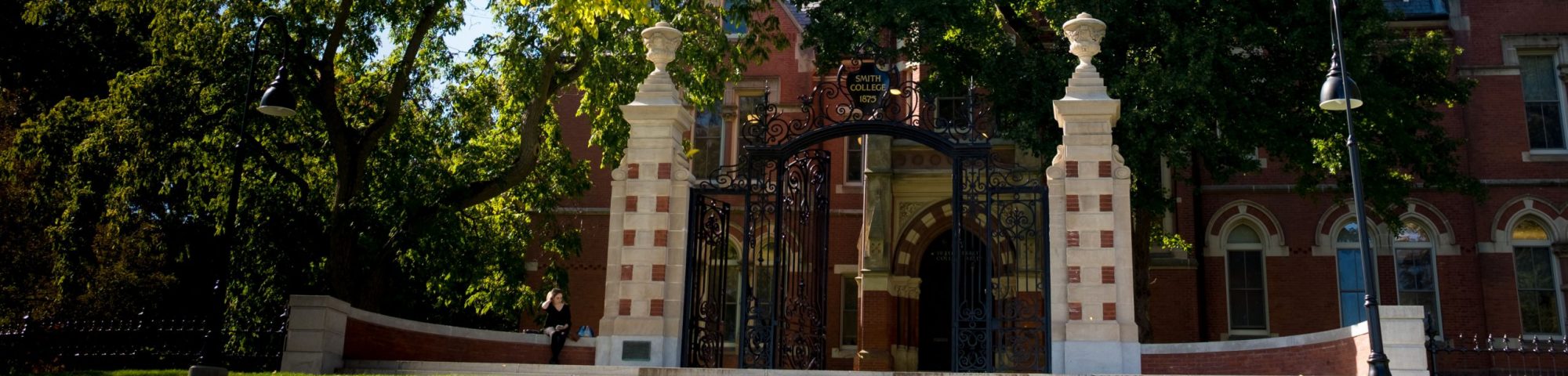
WIMIN 2023 was held at Smith College on Saturday, September 23, 2023.
WIMIN 2023 began with a production of the play Diving into Math with Emmy Noether.
Our plenary speakers were
- Melody Chan, Brown University
- Karamatou Yacoubou Djima, Wellesley College.
2023 Speakers:
Melody Chan, Brown University.
Melody Chan majored in computer science and mathematics at Yale University, winning a Goldwater Scholarship as well as the Alice T. Schafer Prize for undergraduate mathematics research. She studied for the Math Tripos at the University of Cambridge, received a master’s degree at Princeton under the direction of graph theorist Paul Seymour, and received her PhD from Berkeley under the supervision of Bernd Sturmfels for work in tropical geometry at the intersection of graph theory and algebraic geometry. She joined the faculty at Brown University after a postdoctoral fellowship at Harvard. She has received a Sloan Research Fellowship, the AWM—Microsoft Research Prize in Algebra and Number Theory, and is a Fellow of the American Mathematical Society, which cites her “mentorship and mathematical exposition” as well as her contributions to research. In addition, she is an accomplished violinist who studied at Juilliard with Itzhak Perlman and Dorothy DeLay and has performed at the Lincoln Center for the Performing Arts.
Points, lines, and planes: finite geometries
Abstract:
Karamatou Yacoubou Djima, Wellesley College.
Karamatou Yacoubou Djima grew up in Benin, Ivory Coast, and Togo, before moving to the US to study mathematics and engineering at CUNY Staten Island. She first conducted research during her undergraduate years at CUNY, with a project in applied dynamical systems that was directed by Andrew Poje and a project on supersolids in physics directed by Anatoly Kuklov. Her master’s degree and PhD were both supervised by Wojciech Czaja at the University of Maryland in College Park. After receiving her PhD, Karamatou was a postdoctoral fellow at Swarthmore College before joining the faculty at Amherst College and then moving to Wellesley College. Her research interests lie between applied harmonic analysis and machine learning, with an overarching goal of representing data via simple building blocks that both reduce the computational cost of algorithms while preserving relevant information detected from hidden structures in the data. She has applied these techniques in projects ranging from early detection of autism spectrum disorder and macular degeneration to motion detection in Pixar animations.
Classifying medical images using tools from mathematical data science
Abstract:
The conference will take place from 9:00am-5:30pm EDT, and begins with coffee/light breakfast, with the first event at 9:30.
MAP OF ROOMS FOR STUDENT TALKS
Parking Information: After 5 p.m. and before 7 a.m., Monday through Friday and on weekends, visitors may park in the white lined spaces in any lot without a parking pass. We suggest parking in the Dickinson Lot on Green Street or the Parking Garage on West Street. Metered parking is also available on Green Street.
CONFERENCE SCHEDULE
9:00 Registration, Coffee and light breakfast (Wright Hall Foyer)
9:30 Welcome (Weinstein Auditorium, Wright Hall)
9:45 Diving into Math with Emmy Noether (Weinstein Auditorium, Wright Hall)
Coffee and Snacks available before and during student talks on 3rd floor of Burton!
11:15 Student talks in parallel sessions (Various Rooms, Burton/Sabin-Reed Halls)
12:20 Lunch (Campus Center, Carroll Room)
1:20 First Plenary Talk (Campus Center, Carroll Room)
Classifying medical images using tools from mathematical data science
Karamatou Yacoubou Djima, Wellesley College
2:30 Student talks in parallel sessions (Various Rooms, Burton/Sabin-Reed Halls)
3:35 Graduate school panel and Networking/coffee break (Campus Center, Carroll Room)
4:30 Second Plenary Talk (Campus Center, Carroll Room)
Points, lines, and planes: finite geometries
Melody Chan, Brown University