
This page contains the following: sections:
- Where is Russian spoken?
- Climate education in:
- Kyrgyzstan
- Tajikistan
- Climate and culture in (in progress)
- Language practice (in progress)
- References and additional resources
- Russian is the eighth most-spoken language, with over 146 million native speakers and almost 255 million speakers worldwide. It is an official language in 4 countries, including Russia, Kyrgyzstan, Belarus, and Kazakhstan. In Tajikistan, Russian is constitutionally recognized as a language of interethnic communication. The majority of Russian speakers live in Eastern Europe (map and table below). There are three major Russian dialect groups: Northern, Southern, and Central, with modern literary Russian being based on the Central dialect. These dialects differ in vowel reduction and intonation patterns, though the differences between these dialects are fewer than the dialects of most other European languages.
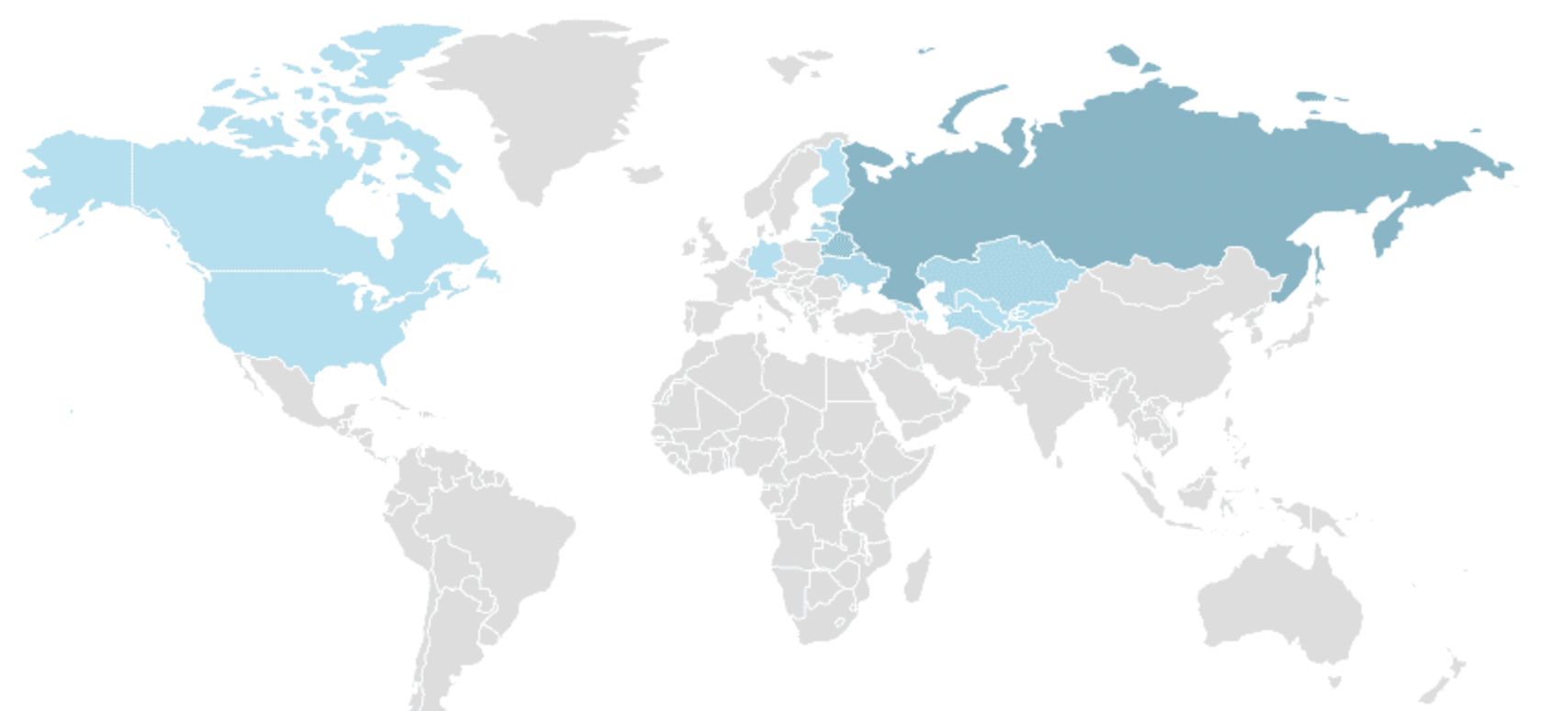
World map of percentages of native Russian speakers where light blue is a low percentage and dark blue is a high percentage. Most native speakers live in Eastern Europe or Central Asia (from Kudelya, 2025).
Climate education in selected Russian-speaking countries
Kyrgyzstan (Кыргызстан)
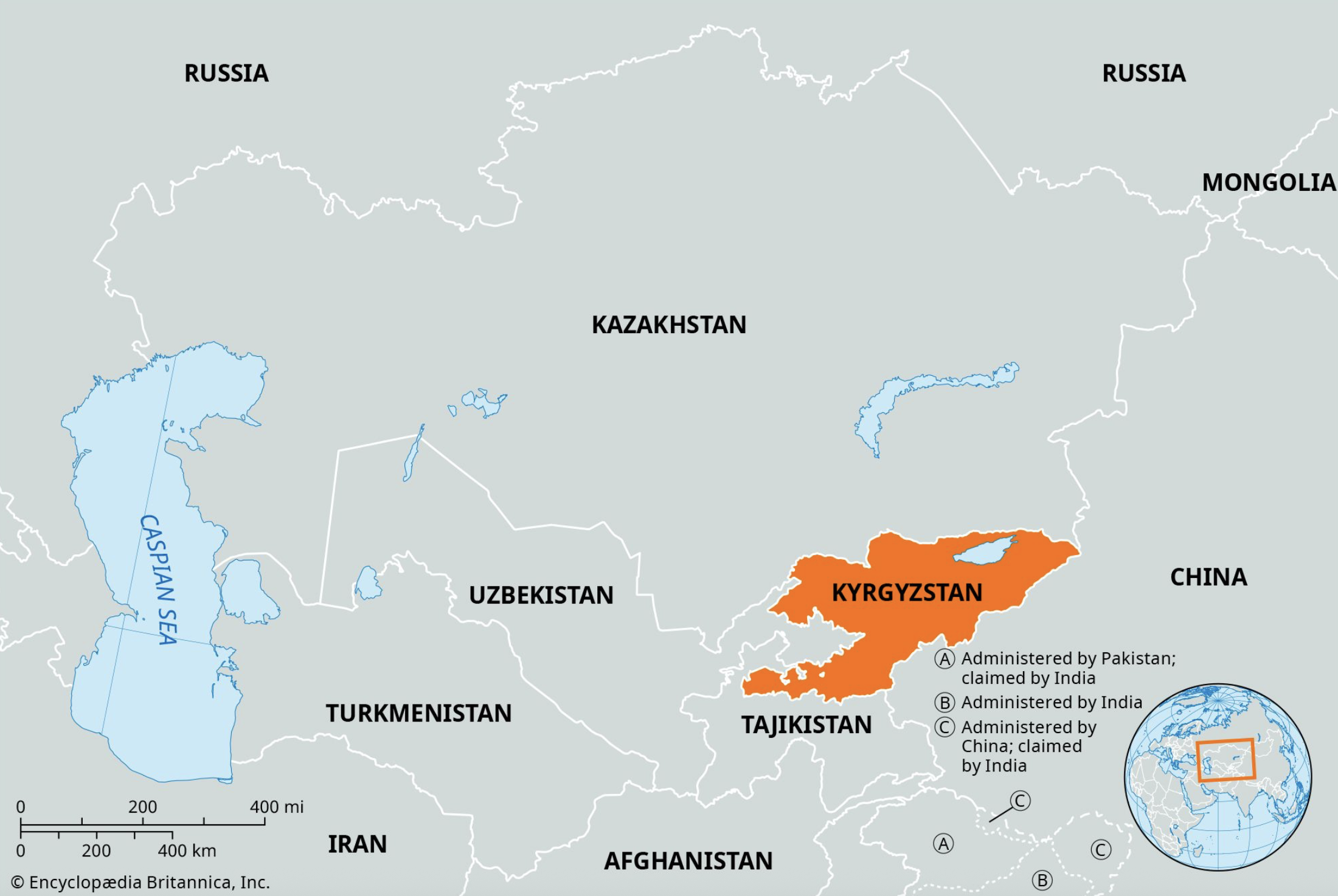
Map of Kyrgyzstan, located in Central Asia, bordered by Kazakhstan to the north, China to the east, Tajikistan to the south, and Uzbekistan to the west (from Allworth et al., 2025).
- You can learn more about climate education (климатическое образование) in Kyrgyzstan through UNESCO and the Monitoring and Evaluating Climate Communication and Education (MECCE) Project here.
- Kyrgyzstan’s geography and topography make it highly susceptible to climate change (изменение климата) and extreme weather. Kyrgyzstan frequently experiences natural disasters and climate hazards such as droughts (засухи), landslides (оползень), avalanches (лавина), frosts (морозы), and floods (наводнения). It is predicted that weather events associated with climate change will be highly consequential for Kyrgyzstan, as the country’s water, energy, agriculture, and infrastructure are especially vulnerable to drastic change.
- With 90% of its energy generated by hydroelectric power plants, Kyrgyzstan is a low carbon-emitting country. However, it is predicted that climate change will reduce water flow while the growth of GDP will increase demand for electricity. As climate change-related impacts and electricity demand continue to rise, Kyrgyzstan will soon face power shortages.
- Kyrgyzstan’s Ministry of Education and Science manages state policy by upholding the right to an education, contributing education-based funding, and promoting scientific activity in the classroom. Kyrgyzstan has implemented many educational standards and strategies to ensure climate literacy, such as the United Nations Economic Commission for Europe (UNECE) Strategy for Education for Sustainable Development.
- SPARE or Simply Saving the Planet is an international school project that operates in Kyrgyzstan to educate students about sustainable energy (устойчивая энергетика), resource conservation, and climate change (измене́ние кли́мата). More than 200 schools in Kyrgyzstan are involved in this project.
- The Climate Box Program was implemented in 2016 by the United Nations Development Programme to promote climate education in Kyrgyzstan’s schools. It consists of educational climate materials to be shared with grades 2-12 with the purpose of fostering an environmentally responsible and aware culture.
- In higher education, climate change is given limited priority, though related curricula are being developed for Masters programs in disciplines like Ecology and Sustainable Development. Climate change lessons are integrated into the Ecology curriculum, which is available for students in all areas of specializations.
- Though adult training is not governmentally financed, some non-governmental organizations offer opportunities to learn about climate change. This training is provided in both formal and informal settings, with many of the targeting groups for these lessons being single mothers, the unemployed, and retired populations.
Tajikistan (Таджикистан)
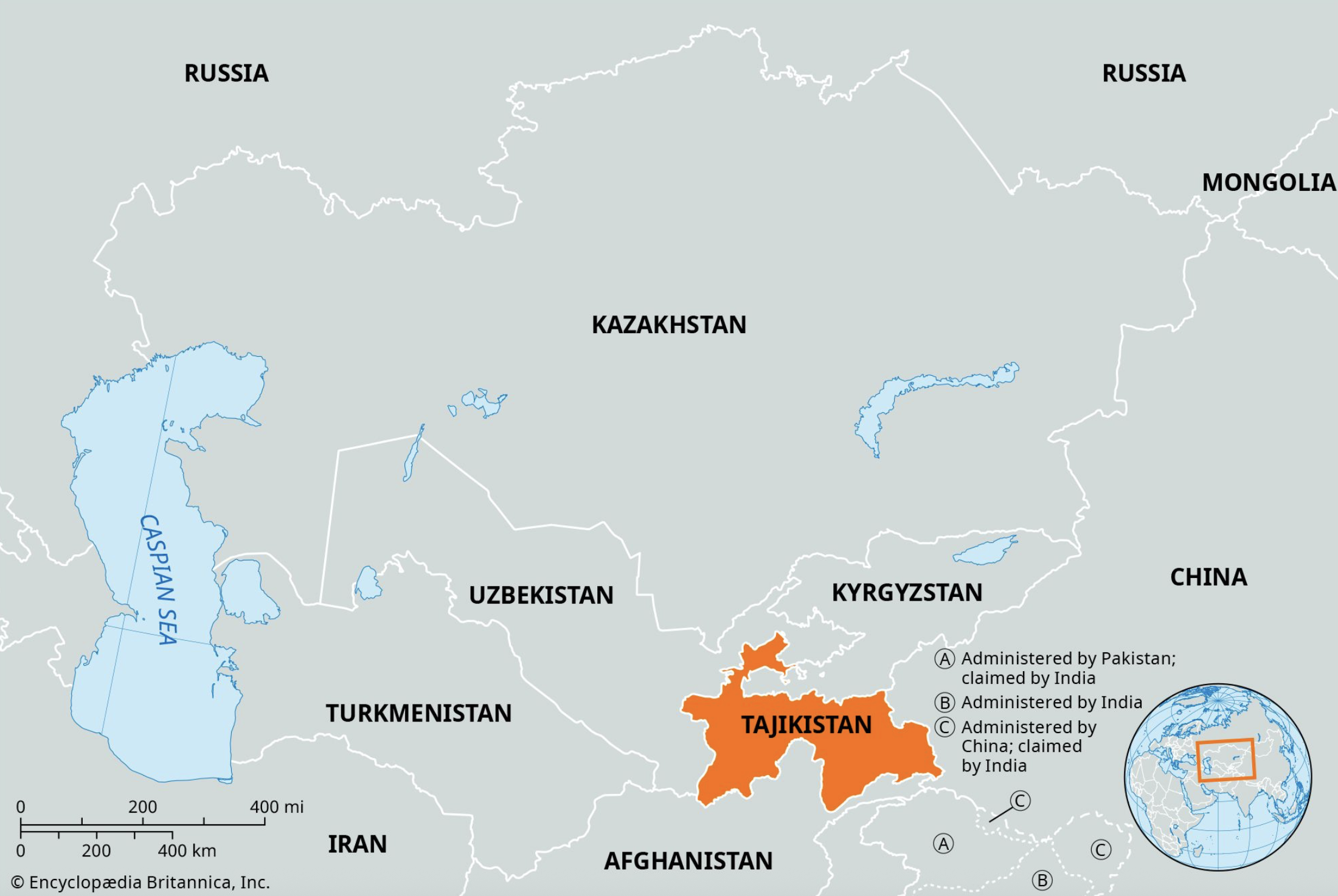
Map of Tajikistan, located in Central Asia, bordered by Kyrgyzstan to the north, China to the east, Afghanistan to the south, and Uzbekistan to the west (from Allworth et al., 2025).
- You can learn more about climate education (климатическое образование) in Tajikistan through UNESCO and the Monitoring and Evaluating Climate Communication and Education (MECCE) Project here.
- Tajikistan’s mountainous, glacial, and forested landscapes characterize the country with continental, semi-arid, and subtropical climates across regions. This leads to extreme seasonal and regional differences in temperature. Tajikistan experiences many natural disasters, including avalanches, droughts, earthquakes (землетрясения), and mudslides (селевой поток). Glacier-fed hydropower makes up 90% of Tajikistan’s energy, but the country is threatened by power and water shortages due to population growth and climate change-related impacts, such as glacial melting. This makes environmental education and adaptation a national priority.
- Tajikistan’s overall population understanding of climate change is relatively low, with surveys indicating that the level of awareness about climate change-related issues varies from 40-80%. Still, significant progress is being made to increase public awareness through mass media coverage and non-governmental organizations.
- Article 38 of the Constitution of the Republic of Tajikistan asserts that “The state shall take measures aimed at protecting the environment”, a statement which serves as a basis for all environmental policies in the country. Climate change is not explicitly mentioned in Tajikistan’s educational laws, though general environmental mandates are enforced in the classroom. Environmental education (экологическое образование) is compulsory in public schools, starting in preschool and continuing throughout secondary schooling.
- Students in Tajikistan are offered many opportunities to further their environmental education. They visit specially protected natural areas to gain skill in understanding the state of the environment and participate in contests and workshops. Tajikistan intends to hold environmental Olympiads to further engagement in environmental education.
- The 2021-2025 Comprehensive State Program for the Development of Environmental Education of the Population of the Republic of Tajikistan is currently under review, and it is not yet known if climate change will be included.
- Little is being done to introduce information on climate change in higher education. While many existing programs aim to develop environmental comprehension and competency, climate-related issues lack emphasis in universities, lyceums, and colleges.
- The Tajik National University, for example, offers training in subjects such as Ecology, Biology, Chemistry, and Geology. It also provides the General Ecology course to promote understanding of environmental use, protection, and law.
- The Tajik Technical University provides training in environmental impact standards and environmental engineering.
Climate and culture in selected Russian-speaking countries
In progress.
In progress.
References and additional resources
- Climate Change Communication and Education. Kyrgyzstan | CLIMATE CHANGE COMMUNICATION AND EDUCATION | Education Profiles. (n.d.). https://education-profiles.org/central-and-southern-asia/kyrgyzstan/~climate-change-communication-and-education
- Climate Change Communication and Education. Tajikistan | CLIMATE CHANGE COMMUNICATION AND EDUCATION | Education Profiles. (n.d.). https://education-profiles.org/central-and-southern-asia/tajikistan/~climate-change-communication-and-education
- Dyer, A. K. (2023). Russian dialects, languages of Russia, and other Slavic languages. Uiowa.edu; Pressbooks. https://pressbooks.uiowa.edu/russiancareer/chapter/recognizing-some-dialects-of-the-russian-language/
- Russian – Worldwide distribution. (n.d.). Worlddata.info. https://www.worlddata.info/languages/russian.php
- Tajikistan | Climate Change Adaptation. (n.d.). Www.adaptation-Undp.org. https://www.adaptation-undp.org/explore/europe-and-central-asia/tajikistan
- The Editors of Encyclopaedia Britannica. (2019). Russian language | Dialects & Development. In Encyclopædia Britannica. https://www.britannica.com/topic/Russian-language
- Zeidan, A. (2023, August 4). Languages by total number of speakers | List, Top, & Most Spoken | Britannica. Www.britannica.com. https://www.britannica.com/topic/languages-by-total-number-of-speakers-2228881
How to cite this page
Russian. (2026, May 25). Climate in Global Cultures and Histories: Promoting Climate Literacy Across Disciplines. Retrieved Month Date, Year, from https://www.science.smith.edu/climatelit/russian/