
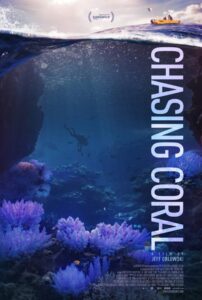
Released by Netflix, directed by Jeff Orlowski-Yang.
- Chasing Coral is an American science and nature documentary following a group of scientists, researchers, divers, and photographers from a wide range of backgrounds, on a mission to record coral bleaching events. These events occur when ocean temperatures rise, the change stresses corals, and they expel the beneficial algae living in them (zooxanthellae), turning entirely white.
- The subjects of the film include Richard Vevers, Phil Dustan, Dr. James Porter, Dr. Ruth Gates, Dr. Ove Hoegh-Guldberg, Jeff Orlowski, Zackery Rago, Trevor Mendelow, Dr. Mark Eakin, Charlie Veron, Dr. Joanie Kleypas, and Dr. Justin Marshall. Furthermore, the Netflix Original documentary was directed by filmmaker Jeff Orlowski-Yang and released in 2017 at the Sundance Film Festival, where it won the Audience Award for Best U.S. Documentary.
- To produce Chasing Coral, the filmmakers captured over 500 hours of footage, a lot of which was submitted by volunteers from 30 different countries. The documentary also includes exclusive interviews of the team, shining light on some of the physical and emotional hardships they underwent while monitoring and filming the coral bleaching. Chasing Coral raises public awareness for the effects of climate change on coral reefs by visually exposing how coral bleaching drastically changes the diverse oceanic ecosystem.
- Coral reefs are an incredibly diverse ecosystem, home to many thousands of species around the world. Beyond their value as an ecosystem, coral reefs also benefit people. Coral reefs support the fishing industry by providing habitat for fish. Furthermore, these marine environments act as a barrier, protecting coastal communities from floods, waves, and storm surges. Tourism in coral reefs is a $36 billion dollar industry, supporting millions of jobs worldwide. Humanity also relies on the organisms in reefs to develop new medicines against a number of diseases.
- You can watch the trailer here or the full version of the film here.
How is this related to climate?
- The documentary was filmed over three years from 2014 to 2017. During this period, extreme coral bleaching occurred throughout the world, one of the most widespread and impactful bleaching events recorded to date. Over 60% of the world’s coral reefs were affected or killed by climate change induced heat stress during that time (image below). From 2023 to 2024, another major global bleaching event occurred, harming over 70% of reefs.
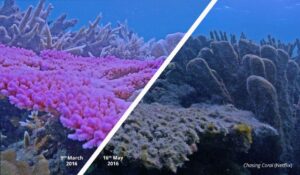
Images of a healthy coral reef in the Great Barrier Reef (off the coast of Australia) before a marine heatwave on the right, and the same reef after a heat induced bleaching event on the left (from Ainsworth, 2019).
- Coral reefs worldwide are being threatened by climate change. These aquatic creatures appear vibrant when healthy. The colors are produced by microscopic photosynthetic algae called zooxanthellae that have a symbiotic, or mutually beneficial, relationship with the coral. The zooxanthellae live inside coral tissue and are corals’ main source of food. Corals are very sensitive animals that are stressed by slight changes in ocean temperature, chemical pollution, increased sun exposure, overfishing, and prolonged low tides. When corals are subjected to environmental stress, most commonly temperature changes, they expel their zooxanthellae and lose their color, a phenomenon known as coral bleaching (image below). In this state, corals have limited food input and are vulnerable to diseases. If conditions return to normal before the condition is fatal, the zooxanthellae can return and reefs can recover. Often, however, long-term bleaching will kill off large expanses of coral reefs.

Diagram demonstrating the three steps of coral bleaching caused by rising ocean temperatures, pollution, increased sunlight, and shallow water (from NOAA, 2024).
References and additional resources
- Ainsworth, T. “Marine heatwaves a bigger threat to coral reefs than previously thought.” James Cook University. August 2019. https://www.jcu.edu.au/news/releases/2019/august/marine-heatwaves-a-bigger-threat-to-coral-reefs-than-previously-thought.
- “Chasing Coral.” Chasing Coral: An Exposure Labs Production. n.d. https://www.chasingcoral.com/.
- “Chasing Coral.” IMDb. 2017. https://www.imdb.com/title/tt6333054/.
- “Chasing Coral Poster #1.” Trailer Addict. January 2017. https://www.traileraddict.com/chasing-coral/poster/1.
- Cheshire, G. “Chasing Coral.” Roger-Ebert.com. July 2017. https://www.chasingcoral.com/.
- Netflix. “Chasing Coral|FULL FEATURE|Netflix.” Youtube. April 2020. https://www.youtube.com/watch?v=aGGBGcjdjXA.
- Netflix. “Chasing Coral |Official Trailer[HD]|Netflix.” Youtube. June 2017. https://www.chasingcoral.com/.
- NOAA. “What is coral bleaching?” National Ocean Service. June 2024. https://oceanservice.noaa.gov/facts/coral_bleach.html.
- “Reporting Coral Bleaching Data and Observations to NOAA Coral Reef Watch.” National Oceanic and Atmospheric Administration Satellite and Information Service. July 2024. https://coralreefwatch.noaa.gov/satellite/research/coral_bleaching_report.php.
- Scott, M. and Lindsey, R. “Unprecedented 3 years of global coral bleaching, 2014-2017.” National Oceanic and Atmospheric Administration. August 2018. https://www.climate.gov/news-features/understanding-climate/unprecedented-3-years-global-coral-bleaching-2014%E2%80%932017.
How to cite this page
Chasing Coral (2017). (2025, February 14). Climate in Global Cultures and Histories: Promoting Climate Literacy Across Disciplines. Retrieved Month Date, Year, from https://www.science.smith.edu/climatelit/chasing-coral/.