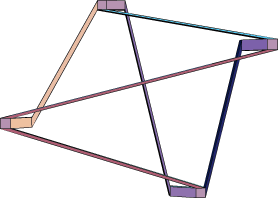
Gaussian curvature is a measure for the "curvedness" of a surface. The basic idea is simple: take a surface with a boundary (i.e. not a closed surface like a sphere). The surface should not have any holes in it, and the boundary should be smooth (no sharp corners). Now take an arrow perpendicular to the surface (i.e. a normal) and let this arrow travel along the boundary of the surface (all the time remaining perpendicular) until it reaches its start point again.
Next imagine having a unit-sphere (i.e. a sphere with radius = 1). Have an arrow point from the centre of the sphere to the surface. While the arrow on the original surface travels around the boundary, let the arrow in the sphere mimic its movement (remaining attached to the sphere’s centre). The arrow in the sphere will now describe the boundary of a part of the sphere’s surface. The size of the surface of this sphere-segment is called the Gaussian curvature of the original surface.
There’s something strange going on here however. The 3 planes of the pyramid are completely flat, so their curvature is zero. The fact that the surface described on the sphere is not zero, means that the curvature of the entire pyramid-surface is, so to say, contained in the top of the pyramid. I.e. the vertex of the pyramid-surface is responsible for the curvature. Or, stating it differently: the sphere-arrows trace an actual surface, because the pyramid-arrows have to cross 3 edges: at those crossings the arrows rotate, tracing out part of a circle on the sphere. Now it’s clear that a pyramid face is projected onto the sphere as a point (the sphere arrow doesn’t move while the pyramid arrow travels along a plane), a pyramid edge is projected as an edge, and a pyramid point is projected as a surface. So yes, indeed the top of the pyramid is responsible for the sphere-surface and so it contains the entire curvature of the surface.
Here is new text in a paragraph.