| Tourmaline
|
|
Property
|
Value
|
Comments
|
| Formula |
Na(Mg,Fe,Li,Al)3 Al6 [Si6 O18](BO3 )3 (O,OH,F)4 |
|
| Crystal System |
Hexagonal (trigonal), 3m |
|
| Crystal Habit |
Striated hexagonal prisms |
|
| Cleavage |
{110} and {101} |
Very poor cleavages |
| Color/Pleochroism |
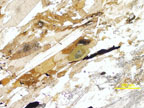
Blue, red, green, yellow, black, brown. (Schorl, the most common tourmaline, is black) |
Strongly pleochroic |
| Optic Sign |
Uniaxial (-) |
|
| 2V |
10 degrees |
Only occasionaly biaxial |
Refractive Indices
omega =
epsilon = |
1.631-1.698
1.610-1.675 |
|
| Max Birefringence |
0.035 |
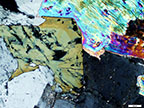
Cannot be used as a reliable guide to composition |
| Extinction |
Longitudial sections show parallel extinction and are length fast. |
|
| Unit Cell |
a = 15.8-16.0 Å
c = 7.1-7.25 Å
Z = 3
|
|
Physical Properties
|
H = 7
G = 2.90-3.22 |
|
| Distinguishing Features |
In hand sample: columnar crystals with rounded triangular cross sections.
Poor cleavage
Deep color often masks interference colors |
| Occurrence |
Tourmaline is a characteristic mineral in granitic pegmatites. It is an accessory mineral in granite, granodiorite, and related felsic rocks. Tourmaline is also a common mineral in schist, gneiss, quartzite, and phyllite. Also found in metasomatically altered limestone and dolomite in contact metamorphic zones. |
| Editors |
Emma Anderson (2005). Data sources: Minerals in Thin Section Perkins, Dexter and Henke, Kevin 2000. Introduction to Opticial Mineralogy Nesse, William 1991. Introduction to Mineralogy Nesse, William 2000. Clementine Hamelin (2013). |