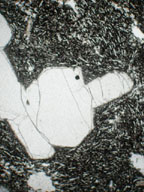
|
Olivine
|
|
Property
|
Value
|
Comments
|
| Formula |
(MgFe)2SiO4 |
Complete solid solution between Mg2SiO4
(forsterite)
and Fe2SiO4 (fayalite). |
| Crystal System |
orthorhombic |
|
| Crystal Habit |
granular masses or rounded grains |
|
| Cleavage |
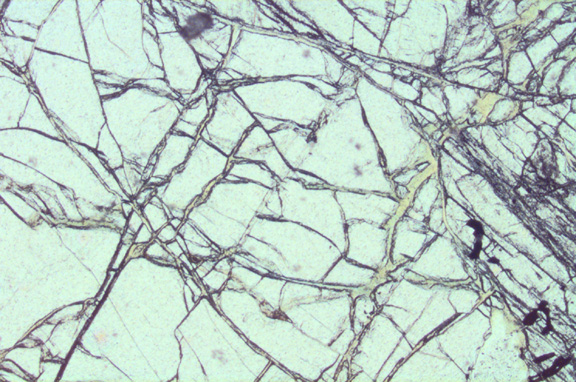
no distinct cleavage |
conchoidal fracture |
| Color/Pleochroism |
Olive or yellowish-green in hand samples. Colorless
to pale green in thin section. Weak, pale green pleochroism in thin
section. |
Can be a yellowish color when rich in iron. |
| Optic Sign |
Biaxial (-); or Biaxial (+) |
if 2V =82-90 it is forsterite and Biaxial (+)
if 2V=46-90 it is fayalite and Biaxial (-) |
| 2V |
82-90; forsterite
46-90; fayalite |
Varies depending on composition.
Click here for graph. |
| Optic Orientation |
X=b
Y=c
Z=a
O.A.P. = (010) |
|
Refractive Indices
alpha =
beta =
gamma =
delta = |
1.635-1.827
1.651-1.869
1.670-1.879
0.035-0.052 |
|
| Max Birefringence |
0.033 - 0.052 |
|
| Elongation |
|
|
| Extinction |
parallel |
Elongate crystals display parallel extinction. |
| Dispersion |
|
|
| Distinguishing Features |
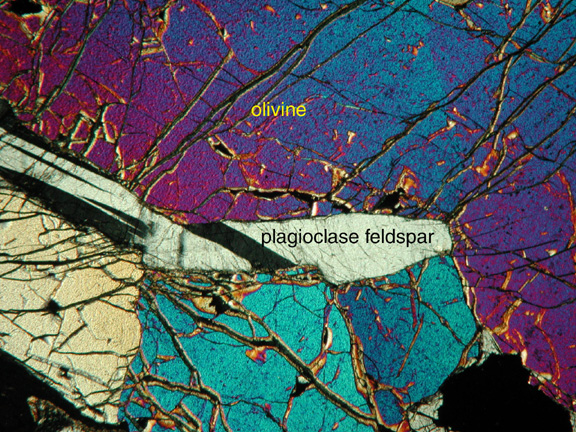
Colorless to olive green in thin section. Second-order
interference colors. High relief. Lack of cleavage. H= 7. G = 3.22 to 4.39.
Specific gravity increases and hardness decreases with increasing Fe. Streak
is colorless or white. |
| Occurrence |
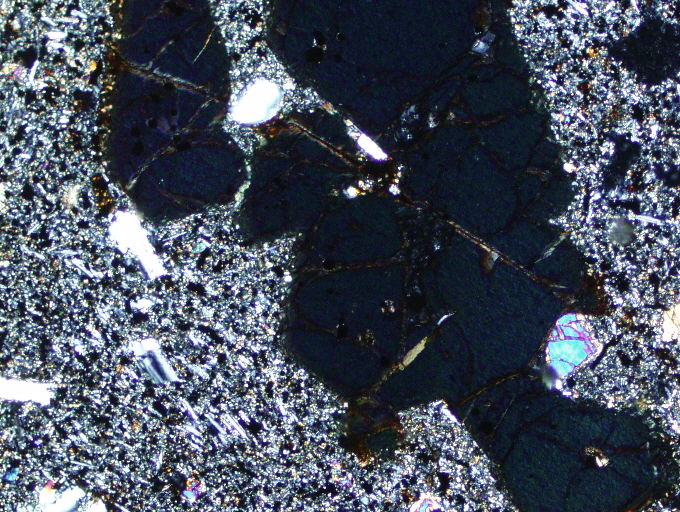
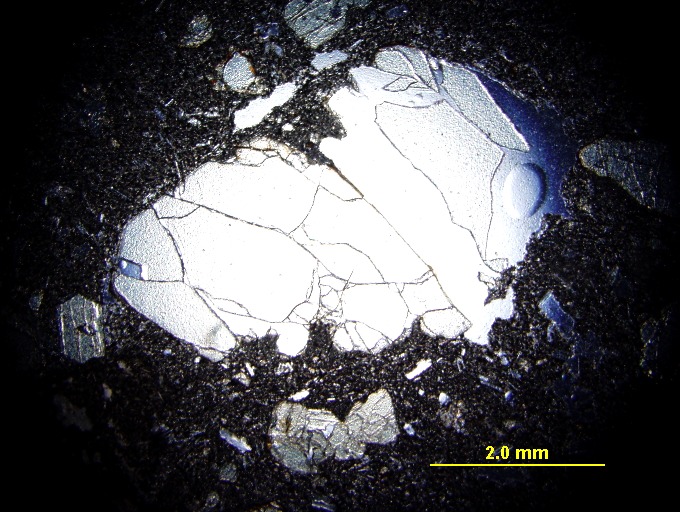
Occurs in a wide variety of volcanic rocks, both as phenocrysts
and as groundmass. Olivine with intermediate Fe-Mg composition is common
in mafic and ultramafic volcanic rocks and plutonic igneous rocks. Iron
rich olivines occur in alkaline and acid plutonic rocks. |
| Editors |
Micehelle Arsenault (01), Jamie Mitchell (03), Angelie
Peterson (02), Cheryl Mawaka (04), Lauren Magliozzi (12) |