 |
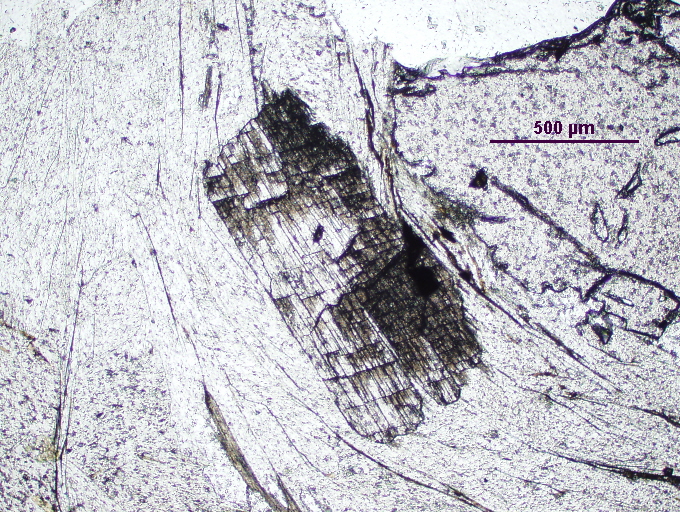
Photomicrograph of kyanite next to a garnet crystal and surrounded by muscovite in plane light. Kyanite typically displays pale green pleochroism and no distinct cleavage. Click on the image to see a larger image with xpl rollover. |
Kyanite |
||
|
|
|
|
| Formula | Al2SiO5 | Fe+3, Ti+4, or Cr+3 may be subsituted. |
| Crystal System | Triclinic | |
| Crystal Habit | elongate crystals in bladed aggregates | |
| Cleavage | Perfect cleavage on 100, good cleavage on 010 | |
| Color/Pleochroism | Pale blue in hand samples. Colorless to light patchy blue in thin section. Weak pleochroism in thin section where X= colorless, Y= light violet blue, and Z= light cobalt blue | Color may be streaky in hand samples. |
| Optic Sign | Biaxial (-) | |
| 2V | 78-84 |
|
| Optic Orientation | Z: inclined 27° - 32° to the c axis Y: inclined 27° - 32° to the b axis X: inclined a few degrees to the a axis |
|
| Refractive Indices
alpha = beta = gamma = delta = |
1.710-1.718 1.719-1.725 1.724-1.734 0.012-0.016 |
|
| Max Birefringence | usually not seen in grain mounts due to cleavages | |
| Elongation | ||
| Extinction | Inclined (see optic orientation). | Bladed crystals display 0° - 30° extinction. |
| Dispersion | ||
| Distinguishing Features | Colorless and dark in thin section with high positive relief! Second-order interference colors. Two prominent, high angle cleavages occur parallel and perpendicular to the length of the crystal blades. Hardness = 4-5 parallel to c and 7.5 at right angles to c. G = 3.53 to 3.67. Streak is white. | |
| Occurrence | Commonly forms in rock types that have undergone high pressures. Kyanite is usually found in metamorphic rocks such as pelitic schists and gneisses. Infrequently found in kimberlite, granitic pegmatite, and eclogite. Associated minerals include staurolite, garnet, sillimanite, and andalusite. | |
| Editors | Wendy Kelly (05) | |
|
Photomicrograph of kyanite next to a garnet crystal and surrounded by muscovite in plane light. Kyanite typically displays pale green pleochroism and no distinct cleavage. Click on the image to see a larger image with xpl rollover. |